28 March 2090

Zombie Wednesday: ...And Then [Nothing] Changed

Ah, zombie survival-horror, that well that started drying up twenty years ago. A few intrepid filmmakers continue to do interesting things with Romero-style undead, but movies like Shaun of the Dead (Wright, 2004), Planet Terror (Rodriguez, 2007), and Dead Snow (Wirkola, 2009) are the exception. Most zombie-moviemakers approach the material with all the artistry of a wedding band covering "We Are Family."

We are family.

I offer a speculation. In zombie movie terms, this is where I stalk into the abandoned convenience store in the second reel, calling "Hello? Anybody in here?" (which is to say, I could die). My speculation: I think the American rage for zombie outbreak movies is a symptom of our hopelessness about collective solutions to collective problems.

What is the fate of groups in zombie-apocalypse movies? They collapse. First, the state goes. Cops die, platoons disintegrate, and politicians run for their survival bunkers; any such groups that remain functional do so by means of ruthless predation on survivors (i.e. the rogue unit that becomes "worse than the zombies"). The family follows suit, as daughters devour fathers, and brothers drag sisters through windows into the waiting hands of the undead.

New, ad-hoc groups form, in shopping malls, or in underground redoubts, or in armed compounds, or in sport-utility vehicles. However, these collapse, too. Individual vices--lust, greed, bravado--lead to an unlocked gate, or an exposed window, or an infected bite. Loner protagonists spurn groups as not merely ineffective, but inherently dangerous, since every other human is a potential zombie. In these 21st-century Robinsonades, lucky heroes end up more isolated than they were at the start of the film; unlucky ones end up dead. Nearly always, the idiotic hunger of the zombie horde is the only clear winner.

The Zombie Family Robinson.

The trope of the contagious, incurable zombie bite suggests political surrender: if you can't beat 'em, join 'em. In the world of zombie plagues (as in the discursive world of neoliberal self-congratulation over the victory of capitalism), somehow you can never "beat 'em." What you therefore must "join" is not an organized army of the undead, who work together to accomplish goals, but a mob of individuals trampling each other as they grab for something to eat. This isn't the joining of a political party or a labor union, but the joining of an undifferentiated mass of individuals that do not acknowledge any commonality. Despite the zombie's tendency to appear in hordes, the horde is a radical negation of the social and the political.

Slovenian philosopher Slavoj Žižek has pointed out a tendency in the imaginary narratives that circulate in today's late capitalist culture.
Thirty, forty years ago, we were still debating about what the future will be: communist, fascist, capitalist, whatever. Today, nobody even debates these issues. We all silently accept global capitalism is here to stay. On the other hand, we are obsessed with cosmic catastrophes: the whole life on earth disintegrating, because of some virus, because of an asteroid hitting the earth, and so on. So the paradox is, that it's much easier to imagine the end of all life on earth than a much more modest radical change in capitalism. (Žižek!)
He does not mention zombies by name, but the zombie-apocalypse film is part of this cultural moment. Our movies can imagine the living dead overrunning a mall; they cannot imagine a mall's living employees organizing a union or turning the space into a cooperative.


Richard Matheson's 1954 novel I am Legend, midwife of the zombie-apocalypse genre, tells the story of Robert Neville, an ex-military man who barricades himself against the vampires who besiege his house every night. These undead are victims of a plague, and now, like junkies desperate for a fix, they are too sick and stupid to work together. By day, Neville scours Los Angeles for useful goods, and destroys any sleeping vampires he finds. He eventually learns (spoiler alert!) that a small group of infected have discovered a drug that allows them to control their disease enough that they retain their intellectual and moral faculties, though they cannot venture out in daylight. The novel culminates in this new society sending a paramilitary squad to capture Neville, to try him for his crimes against their diseased friends and relatives. He acknowledges that he has become their Dracula, their legendary monster that sheds their blood as they sleep.

No zombie movie I have ever heard of goes where Matheson took his undead: a functional society replacing ours. Occasionally, zombie movies since Day of the Dead (Romero, 1985) explore the notion of a single, extraordinary zombie that can (re-)learn to behave socially, but the "smart" zombie is always one of a kind.

Bub: not the average zombie.

This rendering of zombie intellect and sociality as unique reflects American notions of individualism in an era of union-busting, increasing corporate power, and diminishing security for all but the most wealthy. We each root for the one "smart" zombie, identifying with him and congratulating ourselves for being the one who doesn't just follow the rest of the horde, hoping that we'll make it to the last reel (or become a billionaire). When people dress up as zombies and participate in "zombie walks," they make play out of real but historically specific feelings of isolation and hopelessness, their quirky and individualistic cosplay a mockery of the real condition they loathe to recognize. Zombies are free from all social obligations, but they are free only to stumble along in search of food.

Thus the notion that in a zombie apocalypse "everything" changes obscures the more fundamental narrative of zombie movies, where nothing changes except for a slight acceleration of the processes of atomization that have been eroding Americans' sense of sociality for decades. Zombie apocalypse movies are not radical visions of disruption and revolution, but neoliberal visions of continuity and (d)evolution. A zombie movie in which zombies establish worker-owned factories or build public schools or bring manufacturing back to the United States from overseas--that would be a zombie movie where everything changes.

23 April 2012

Public Art and Animal Adoptions Steampunk Style!

Is this a clothing boutique, or an animal-adoption center, or a cosplay clubhouse with a "kraken" pulling an "eighteen-foot zeppelin" through the ceiling? Watch Donna Ricci's [revised] video for "Public Art and Animal Adoptions Steampunk Style" and you may be able to answer that question. Then again, I've watched it, and the idea remains blurry around the edges.

Contribute, or someone will strap goggles to each of these animals.

And what does all this have to do with Doctor Who? Ricci also plans to build a TARDIS outside the boutique, a prop that "will be available to the public 24 hours a day." Is this the "public art"? If I LARP on the street or wear Klingon-face to Burger King, is that public art? Do people claim Doctor Who as steampunk? What does this have to do with stray dogs and parakeets?

Maybe I'm in the wrong simply for asking such questions. Ricci asserts that steampunk is "based around science-fiction," "largely based in the Victorian era," and "almost beyond definition--there is no right or wrong answer." Problem solved: steampunk is whatever you want it to be. If there's some Victoriana in there, all the better, but medieval Scandinavian sea-monsters and 1960s British science-fiction TV shows both count as steampunk, as do stray dogs and clapper-boards with digital displays.

I assume that the popularity of steampunk doesn't spring from nostalgia for late-19th-century scientific racism, or Jim Crow, or America's colonial adventure in the Philippines, or laws that kept women from voting, or police repression of the labor movement--but I could be wrong. Now that I think about it, the lack of interest in the actual 19th century on the part of steampunk fans suggests that I am wrong.

Is steampunk then a symptom of postmoderns' nostalgia for modernity, for that reassuring sense that humanity is making Progress? There is an undeniable beauty to modernity's grand narratives, wherein we will someday fly personal aeroplanes to our 20-hour-a-week jobs, or explore the universe in soviet-built rocketships. In the US, at least, we seem to be returning to the Gilded Age of robber barons and tentacled trusts; is "steampunk" a way of imagining a liberated but individualist fantasy of that period, where artisanal rocket boots, and not unions or political parties, can save us from bread lines and 12-hour workdays?

18 April 2012

Tangentially Zombie Wednesday: Rise of the Steam Goddess

I'm glad the word steampunk is so popular, because it's a real time-saver. It's like a handkerchief on the roommate's doorknob, code for "MASTURBATING--DO NOT DISTURB." Don't worry, bro! When you drop the s-bomb, I realize that wanking is in progress, and I can spare both the wanker and myself the shame of discovery. Unless, that is, I'm doing research for new Shitstarter posts. In that case, I kick in the door.

Dame Frances "Fanny" Juggins, Lady Bustington

I know what you're thinking. Some of you were reading along, and then when you got to the photo of Dame Fanny (above), you lost track of what I was saying. A few of you might even have hoped that this woman was the artist responsible for the Kickstarter project, or at least that she appears in the video; after all, a big PLAY button hovers just above her endowments.

But such is the visual rhetoric of Kickstarter pages like the one for Ben Hamby's Rise of the Steam Goddess. Not only is Dame Fanny not the party responsible for the page, she does not even appear in the video. She is the bait, and Professor Hamsley Piggins, Marquess of Bloatingsford (below), is the switch. If you don't believe me, watch his video, which consists of Piggins sitting on a couch and holding forth about his novel of "steam-powered zombies" in a cod-English accent that made me consider, in this order, homicide, suicide, and genocide.

"I know all there is to know about the crying game." --K.K. Rotwang

Steampunk has become the sink into which SF fandom drains its porky, some-college mediocrity. For fans with a DIY impulse, it's a snap: buy an olde-tyme hat on EBay or at the Halloween store, glue some feathers and watch parts to it, and vòila, le punk--le punk de steam! Making a convincing suit of mail, Dalek-voice ring-modulator, or bat'leth takes way more work. Besides, unlike "boffer" (i.e. foam-weapon) LARP, steampunk demands little exertion, apart from squeezing into those getups. No, you won't see any mob of steampunks chasing about St. James Park, clubbing each other with foam bumbershoots, eh, guv'nor?

Steampunk is specific enough to be useful to my purposes--I can search for the word in Kickstarter and find no shortage of awful self-promotion--but it is also a vague enough buzzword to attract all manner of "creative" awfulness to its banner.

Long live steampunk.

16 April 2012

POLE-ITICS

This Kickstarter project from Emilee Wilson aims to "show the world that pole dance is a sport." "Everyone knows it is a form of fitness," she asserts, "but does it belong in the Olympic Games?" 

[Your pun HERE!]

You're probably thinking, "Pole-dancing? Isn't that what strippers do?" Wilson and company are adamant that pole-dancing is not stripping, and that it is not done for money; their slogan, "no tipping and no stripping," appears both in the text description and in the video. It seems that Wilson is trying to deflect charges that pole-dancing is little more than slightly de-sexualized striptease. The implication is that because athletic/artistic pole-dancers do not take off all their clothes, and because they do not expect to have spectators give them cash, athletic/artistic pole-dancers are somehow nobler than women who dance nude around poles for money.

This strikes me as deeply ironic, in that it suggests an anti-feminist position regarding female sexuality and sex work. The position seems to be that it's OK for women to be sexy, as long as they aren't going to do any lap-dances, and that (maybe) it's OK for women to have sex, but it's not OK for them to have sex in exchange for money.

(In the interest of full disclosure, I should state that while I find mostly- and entirely-nude women fascinating, and while I also think that it should be legal for consenting adults to pay for striptease or for sex, I nevertheless find stripping and strip clubs repulsive. There's something about the tease of the dancing that I find personally degrading and humiliating. I hate that I can't look away from nude women who have no intention of getting to know me, let alone having sex with me. I respond like Pavlov's dog to the ringing of the bell, fully aware that my dish will remain empty. Strip clubs expose and exploit my desires without my consent.)


To return to Wilson's argument, consider the above still from her promotional video. Pole dancing isn't stripping, Wilson claims, but the video's images say otherwise. Here we see an athletic young woman with shaved limbs and a cultivated tan spinning around a pole, an iridescent curtain behind her. She wears thigh-high boots with six-inch heels. Her bikini top and bottom have bows, which suggest tying, but also--and more strongly in this context--un-tying, with a single tug. A jewel in the dancer's navel reminds us to look at her lower abdomen, while the lighting and the framing prevent us from looking at her face. Everything about the scene evokes strip clubs, and a classically eroticizing and objectifying male gaze, since this creature has no face with which to look back.

Thus the brand of pole-dancing that Wilson promotes simultaneously reminds us of women dancing in strip clubs even as Wilson and company disavow that same practice. We get the worst of both worlds: the ogling and sleaze of Roxie's at 2 AM, mixed with an equal measure of Puritanism and slut-shaming.

Consider this thought-experiment: imagine an Olympic event based on hard-core pornography. No money changes hands and nobody's genitals are exposed. Male dancers dress in black PVC thongs and bondage harnesses, and female dancers dress in lacy lingerie or leather bikinis. They perform the contorted sexual moves of gonzo pornography and live sex shows, while judges give them points in different categories. It's all strictly PG-rated. If you note the resemblance to videos of secretaries servicing well-hung bosses, or Japanese-girlschool dildo parties, or black-on-blonde anal gangbangs, the judges will arch their eyebrows, peer over their opera-glasses, and tell you that this is a rigorous sport.

In answer to Wilson's question, I'm going with, "No, pole-dancing doesn't belong in the Olympic Games."

13 April 2012

Bonobo Chat: An App for Talking with Apes

Ken Schweller, a professor of computer science and psychology, has developed software that helps humans communicate with chimpanzees. I lack the training to evaluate his research, so I can oly hope that it is as good as his Kickstarter page, which is gold.

I'm throwing this into my next PowerPoint,
to make sure my students are paying attention.

Prof. Schweller built a Robo-Bonobo. Here Scwheller plays "The Lion Sleeps Tonight" on a harmonica, as a super-title tells us what the Robo-Bonobo thinks.

What has science done?

What will the bonobos say to us? Whatever it is, it won't top Scwheller's Kickstarter page. And will it matter, once Schweller equips his bonobos with tablet computers that allow them to remotely control the Robo-Bonobos?

The bonobological singularity is here.

11 April 2012

Zombie Wednesday: Rebel Wellness Gardens - 'We Survived the Zombie Apocalypse'

Some people seem incapable of getting motivated unless they imagine that society has collapsed due to a zombie apocalypse. Exercising? Donating blood? Preparing for utility outages? Gardening? Bo-ring! But if you make them part of a zombie apocalypse in which all human institutions collapse, where survivors play Robinson Crusoe in the ruins of modernity, then everything becomes jolly funtime.

We make survivalism FUN!

So Andrew Smith's zombie-themed primer on starting a community garden should come as little surprise. It takes the resurgence in gardening and the locavore movement and combines them with the old zombie apocalypse. The twist is that in this scenario, the zombie part is over. I imagine that gardening after a zombie apocalypse is... much like gardening before a zombie apocalypse, but the garden-stores are all closed, and you have to pump your own water. Really, the only time that the gardening experience is significantly different is during the actual zombie apocalypse.

What surprises me is that Smith didn't combine zombies and locavorism with that fad that keeps walking, despite smelling dead: the praise of bacon. Zombie apocalypse bacon! What's more DIY than raising your own pigs and slaughtering them? You get to fight the ghouls that try to invade your compound, while inside, you learn about swine husbandry, slaughter, and processing. Dispatch the pig with a well-placed bullet or blow from a tire iron (remember: you must destroy the brain!), then cook the pig whole, and you and your cosplay friends can tear your dinner apart with your bare hands. Appendices will explain how to make organs and gristle into sausage.*

NOM NOM NOM NOM!1 NOMMERS! NOMzorz!

Here are some other ideas that Smith's project has given me.
The Rock-and-Roll Knitter's Handbook to Surviving the Zombie Apocalypse. (includes patterns for knit rifle-cases and tactical vests)

A Cosplayer's Guide to Building Props that Would Survive a Real Zombie Apocalypse (but Still Look Like PVC).

This Fixed-Gear Cupcake Kills Zombies!

This Bacon Kills Zombies, or The Steampunk Slaughterman's Primer on Surviving the Revenant Deceased in a Manner Befitting Subjects of Her Majesty, with Appendices on Goggles, Pneumatic Captive-Bolt Stunners, and Abattoir Corsetry.
*Note: You must process all the flesh quickly, to avoid putrefaction. Gore effects master Tom Savini bought real pig entrails to use in the dismemberment scenes of Day of the Dead (Romero, 1985), but a member of the production crew accidentally unplugged the refrigerator, letting the guts begin to decay. By the time the crew filmed the scene using the decaying viscera, the stench was enough to make most of them ill.

09 April 2012

Hovercraft Amps

Kickstarter is like an enormous used-record store. I spend most of my time there looking for early-70s LPs bearing photos of guys whose only hope of ever getting laid was starting a band. Every now and then, I find a record I consider buying for non-irony value. Once in a long while, I find something so rare and wonderful that it brings tears of joy to my eyes, say a test-pressing of Black Sabbath's Master of Reality, or the stack of Los Crudos EPs and splits that someone stole from my apartment on Arsenal during a party in 1996. Hovercraft Amps is such a find.

"A mountain walked or stumbled."

If you want to know what kind of amp tone makes K. K. Rotwang consider turning to crime to possess it, play the video on Hovercraft's page. It's not a "good" promotional video, by Kickstarter standards. The campaign's creator, Nial McGaughey, does not stand before the camera making a heartfelt appeal for money, or cracking jokes about the difficulty of starting an artisanal retro-amp workshop. No sophisticated editing suggests high production values. McGaughey just points the camera at the cliff-face of a Hovercraft half-stack, then lets the forces of tube-driven nature take their course.

That course consists of irradiating you with wide-frequency ionizing tube overdrive until your skeleton glows, causing your flesh to boil away and ignite in a slow-motion doom-cloud that dissolves the objects around you. When you are a luminous skeleton-ghost, held together by bong-resin and infra-bass hypergravity, then your 666th chakra will open, connecting you to the One Riff coterminous with all time, space, birth, and death.

06 April 2012

St. Louis Week: "The Shaft Build"

This Kickstarter project promises to revise our understanding of our world, starting with our understanding of the Great Pyramid of Giza. It's not a monument to a dead pharaoh; it's "a stone steam engine built by the Atlanteans 12,000 years ago."

"Just talkin 'bout [Atlantean steam engines]!"

The author clearly understands the potential significance of such a finding, and therefore poses following a rhetorical question: "If you could completely rewrite 12,,000 years of world history, enlighten 7B people, and solve Man's oldest, and greatest enigma, would you do it?" [sic] Clearly the writer has contemplated re-writing world history. The pity is that he didn't bother re-writing the text of his Kickstarter page, the one where he asks us for $62,000 to support his outsider scholarship (and outsider punctuation).

The author is not shy about his qualifications to revise our understanding of human history. According to his autobiographical sketch, he is "A literal renaissance man," one having "vast exposure and experience in Engineering, Design, Sewing, Machining, Surveying, Writing, Acting, Philosophy, and Spirituality." Literally.

His video runs over nine minutes, but evinces high production values. In the interview that dominates that video, he explains his qualifications in another way, and explains his methodology:
I'm not a scientist. I can give you a laundry list of what I'm not. I'll tell you what I am, though. I specialize in one simple thing: free and independent thinking. Newton called it pure thought. I think unobstructed by opinions, unobstructed by schools of thought, even unobstructed by the evidence. The evidence of the other hundred-and-eighteen pyramids up and down the Nile will block the starting point. The evidence of written history will keep you from the starting point.
Let's hope the evidence doesn't keep the author from his $62,000 goal.

04 April 2012

St. Louis Week: Life's Interesting Dramas

Here's a Kickstarter project that might interest afficionados of outsider art, or social workers apt to call the cops on parents who make their kids read Daddy's poetry on YouTube. It's a reversal of the usual, "Lemme read you this goofy thing my kid wrote."

Aww, Daaaad...

The author's poetry not only rhymes, but it resonates with contemporary debates about the growing inequality of wealth in the US:
Never forget who controls all wealth,
Your life breath, your possessions and your health.
For all the silver and gold passing through many hands,
Vast and innumerable as the oceans and sands,
Belong to The Maker who created this world,
When the ugliness of hunger and homelessness is unfurled.
Call me insensitive to poetic impulses, but I don't find the speaker's claims reassuring--but this Blog Post isn't about me or my Desire to expropriate the rich. This is about the Poet, and his random Capitalization, which I can only hope is as unpredictable in Life's Interesting Dramas as it is on the Kickstarter page that describes said anthology as "the Book of Poetry with 100 of my very best poems covering a variety of Topics."

The project goes beyond poetry. The book includes paintings by the author.

"I got the [painting], a ménage à trois/ Musta broke those Frenchies' laws..."

I must admit that while I don't know much about painting, I sure like this one. See, I like to imagine I'm the one in that room, and the painting is what I'm seeing, because that naked lady is giving me the "Paint me, Big Boy" eyes. Furthermore, the lady with the deltoids and the cleavage is giving me the "I can't believe you're going to paint her while I'm in the room... yet I find the prospect thrilling" eyes. (It must be the wine.) It seems we're in Paris, where people are classy and drink wine and put things on pedestals. My presence here suggests I'm on vacation, and able to afford to go to abroad on vacation. If I were really in that room, I'd turn the portrait of the epaulette-wearing guy to the wall and show Miss Nude France how we paint 'em in the U. S. A.

(Then again, the painting also makes me want to call the Missouri Department of Social Services' Child Abuse hotline.)

Yet the artist's ambition does not end here. Life's Interesting Dramas is to comprise not only the book, but an "animated movie." Is this the "Classical Movie" of the Kickstarter page's title? I am curious to see how the artist realizes his "classical" vision in animation.

02 April 2012

St. Louis Week: Gimme Gimme Gimme

Kicking off St. Louis Week on Shitstarter, we have this project, in which Robin Tidwell aims to raise money for a "new novel." That's all we get to know--not the title, not Tidwell's reason for soliciting money, not her previous work or lack thereof. The "About the Project" text appears to consist solely of the first few pages of the book, her survival-horror narrative's in medias res beginning.
     She took the phone call out in the hallway.
     “No names. It’s time. Are you okay?”
     “Yes. I’ll be taking the side roads.”
     “Good. Someone needs to be picked up. See you soon. Good luck.”
     Abby tapped her Bluetooth and disconnected. She stepped back into the locker room and cautiously peered around the corner. The office at the far end of the room had the curtains pulled shut tightly; she knew what that meant. She closed her eyes for a moment, saying a prayer, but only for a moment. It didn’t pay at all to be unobservant.
Two lines into this novel and I'm already confused. Who is talking? Who is listening? Who is the antecedent of that first word, she? I suppose it's Abby, but I don't learn that until four lines later. What's an office doing in a locker room? Not only does Tidwell make St. Louis look bad by not saying so much as please when she asks total strangers for money to write her novel, she can't write her way out of a locker-room. (My confusion about speakers and spatial relationships is almost enough to make me ignore the gratuitously adverbs and the product-placement. How sad is it when a brand name is the most vivid detail in a novel's opening?)

Not pictured: anything related to this new novel.

Furthermore, Tidwell has not bothered to supply us with an image that tells us anything about this novel. The above photo shows some old books, but look at the spines. These are reference books, not novels. The image gave me an idea: maybe the author had Googled some lazy phrase like "old books" and used one of the first few hits as the image for her Kickstarter page. So I tried it. I did a Google image search for keywords old and books, and the above image was the fourth hit.

I've seen Kickstarter pages that stunned me with their egregious writing, or their Hindenburg-explosions of fonts, or nine-minute promotional videos shot in mop closets, but I have never seen one that took less work and care.

26 March 2012

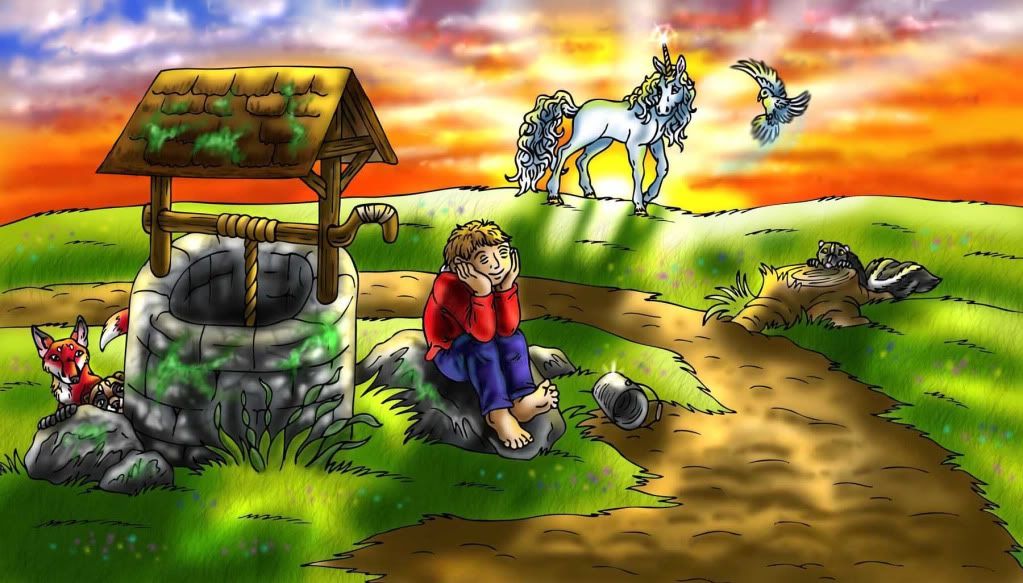
Echant with Christed Light

This Kickstarter project aims to launch a series of spiritually-instructive children's books featuring unicorns, talking birds, hay-varmints, and a barefoot white boy named Chadron. The first book, Rasazar an Enchanted Unicorn, "sets the stage for the next two books dealing with Christed Light, (Reiki), the calling of the Great Spirit and the dark side. In this book they will learn about such things as pink being the color of forgiveness and what unconditional love means and much more."

Chadron and Rasazar: BFFs.

"Christed Light" seems, on the basis of my cursory Internet research, to be a real thing--inasmuch as any New Age re-purposing of actual religious doctrines counts as a real thing. This video explains Christed light. I think.

Chadron gets lit.

But not all is Christed Light in our world, or the author's. She has faced major obstacles, including "the unforgiving illnesses of schizophrenia and bipolar disorder," which make me less inclined to dismiss this project as the ramblings of a kook, groping toward comforting, mystical solutions to the realities of mental illness and America's lack of a first-world-style government healthcare system. The project appears to be exactly that, which is why we should not dismiss it.

The author notes that "the reader will receive Chakra Color Therapy as they read and view the pages." This, too, appears to be a real thing. Something tells me that this book would make a great slideshow, especially if combined with psilocybin mushrooms and a beanbag chair, provided I could forget about the schizophrenia.

23 March 2012

Epic Abuse: Short Films

From now on, anytime I hear anyone use the word epic to describe something that isn't (A) a narrative poem (B) hundreds of pages long and (C) written in a lofty style (D) about heroes in the historic past, I will cough the word bullshit. If the inspiration is upon me, I will cough something like I hate that people who don't understand the words coming out of their own mouths are the engine of linguistic change, turning useful, specific terms into vague buzzwords.

An epic pile of dishes.

Then Patroclus said, "Achilles, son of Peleus, 
who in future story will speak well of you, 
unless we put away these dishes, washed
by fallen Argives? Lend me your towel, 
and I who am fresh might drive these plates 
back into the cupboard."

Calling a big pile of dishes epic is silly, but it's excusable, because dishwashing doesn't presuppose any narrative or artistic ambition. Nobody begins soaking last night's meatloaf pan with an invocation to the muses.

"Of knives and the sponge I sing..."

However, the making of art, and the making of a Kickstarter page to ask strangers for money to finish or to promote that art, does presuppose narrative or artistic ambition. You might think that people with such ambitions might be careful not call their bro-comedy films epic, and that they wouldn't call their self-described "short" films epic, either.

You would be wrong.

21 March 2012

The Vivian Girls: A Play with Music.

Admit it: you have been waiting for a musical about Henry Darger, too. If you donate to this Kickstarter project, you might just get to see and hear one.

Henry Darger was born in Illinois in 1892 and died in 1973. An orphan, he worked as a janitor and lived as a recluse during his long life, attending Catholic mass every day. After his death, his landlord discovered in Darger's apartment a cache of hundreds of paintings, journals, and manuscript narratives, including The Story of the Vivian Girls, in What is known as the Realms of the Unreal, of the Glandeco-Angelinnian War Storm, Caused by the Child Slave Rebellion, an illustrated prose narrative that ran over 15,000 pages.

By Darger standards, this is not even close to weird.

The video for the musical play's Kickstarter page runs too long (seven minutes), and the song lyrics muddy the creators' interviews, but let's not quibble. Henry Darger would have made a seven-hour Kickstarter video, starring only his mumbling self, featuring paintings of nude intersex children riding to war on butterfly space-dragons, set to music that he played on instruments made of tin he scrounged from garbage dumps. Then he would not have even uploaded it to the Internet, but instead left it for his landlord to find.

These artists are insiders, but let's not hold that against them.

This musical commemorates the work and life of a man who lived in a major city, in the most technologically advanced country on Earth (for its time), and who belonged to its dominant ethnic group (white), yet who had the ill fortune to lack the economic and cultural resources to channel his talents into normative routes like professional illustration, commercial writing, or high art. Help playwright Stacy Sims celebrate the work of this outsider.

19 March 2012

"Gods Word" or God sWord?

What is the evangelical Christian SCUBA enthusiast supposed to wear, secular SCUBA enthusiast t-shirts? Well, not anymore.

He hath loosed the fateful [bubbles] of His terrible swift [fonts]...

The examples of Breathe Life's designs that the video displays make me feel as if I ascended too rapidly and got the bends. According to the makers, "By wearing your Breathe Life Dive Wear shirt you will be fulfilling our mission by 'Spreading God’s Word, providing the Sword of the Spirit to carry out God’s plan.' We’re on a mission with a promise!" They don't tell us what the promise is, or what they plan to do with that sword.

I guess I'm not familiar with that translation.

In their video, they explain that they won't limit their designs to SCUBA diving, but will include "spear fishing, cave diving, snorkeling, and general water-related Scriptures for everyone." Jesus can be your spear-fishing buddy.

I will fear no eel-sharks.

Postscript: On second thought, I will fear eel-sharks. If there's one thing I learned from Leviathan (Cosmatos, 1989), it's that that eely thing is probably a Soviet "experiment that tampered with nature's most basic laws." (If there's two things I learned from Leviathan, the second is that a budget spent mostly on sets and lighting won't make your mash-up of Alien and John Carpenter's The Thing grow legs.)

And if there's one thing I learned from watching both Leviathan and Deepstar Six (Cunningham, also 1989), it's that each movie features one of the main actors from Robocop (Verhoven, 1987): in Leviathan, Peter Weller; in Deepstar Six, a scenery-chewing but still under-used Miguel Ferrer. Curiously, 1989's other deep-sea monster movie, The Abyss (Cameron), features no actors from Robocop. Where were you on that one, casting director Howard Feuer?

16 March 2012

...And in the basement bind them

I like that the author of Necromancer: Corruption demonstrates a knowledge of epic fantasy novels.

The other eight Nazgul want their rings back.

Many artists who use Kickstarter show a striking lack of interest in their chosen medium. It goes something like this:
I wrote a screenplay, but my coworkers said I should tun it into a sci-fi novel, so I did. My influences are Deep Space Nine, Farscrape, Battlestar Galactica and Firefly.

Here is my zombies comic book. I got the idea from riding the Mine Train ride at Six Flags in St. Louis at Halloween. If you love zombie movies then my comic is fo r you!!
Kevin "Necromansy" Cunningham (my nickname, not his) breaks with this sorry pattern. He declares, "I read through the Wheel of Time series, the Dark Elf Trilogy, and even classics like Lord of the Rings."

Even Lord of the Rings! I mean, R. A. Salvatore, sure, but Tolkein? He was probably dead before Necromancer was even born. That is dedication to the craft: reading books written by people who could not possibly autograph your copy.

14 March 2012

Zombie Wednesday: Zombie Brewing

I wanted to dislike this Kickstarter project. The text doesn't have a thing to do with zombies, so I thought, "Oh, somebody slapped the word 'zombie' on a thing to make people think it's edgy, cool, and 2005."

Try our new bacon steampunk cupcake.

After watching the video, I'm even less convinced that zombies are the best way to distinguish this brand. Why not name it for the neighborhood, or some distinguished person born there? Nevertheless, I want this backyard-brewery to succeed. They make dog treats out of some of their spent grain, and donate some of it to a horse farm!


A first: a zombie making scare-quotes.

Pledge money to Zombie Brewing, or the animate dead will frighten this dog.

"Ruh-roh!"

12 March 2012

Perduellis, "a sci-fi action thiller book"

Ah, the failed screenplay that becomes a novel, that old staple of Kickstarter projects.

Stupid movie studios. What do they know?

Imagine how different our world would be if movie studios had had the wisdom to buy the screenplays The Man in the High Castle, The Left Hand of Darkness, and Dahlgren, rather than leaving their authors to pad them out into ACE Doubles. (To be fair, we didn't really have the special effects to do justice to The Man in the High Castle until the last ten years or so, but still.)

At least D. A. Karr understands the barriers she faces: "Because this is sci-fi and fiction, it's more difficult to sell then non-fiction." (Aspiring SF writers, take note: disguising your gender by using the old initials-only trick doesn't work if you include a detailed bio.)

Sci-fi or fiction? ...or both?

Originality is key when turning failed screenplays into novels, for as Karr points out, "There is only so many ways you can write about a spaceship that doesn't resemble 'Star Trek.'" You, aspiring writer of failed-screenplay-novels, must find this ways.

I know what you're thinking: "What model is a novelist supposed to use, if not Star Trek? I guess there's Space: 1999, but I can't even get that on Netflix instant-view! What am I supposed to do, spend all my free time chasing down obscure DVDs?"

Nobody said being a novelist would be easy.

09 March 2012

Laughing My Way Through Alzheimer's

Sometimes, the catalog speaks for itself:
There is nothing funny about caring for a loved one with Alzheimer's disease or other forms of dementia. OR IS THERE?

That was a rhetorical question.

07 March 2012

Galactic Biology 101: Slowly but Surly

This Kickstarter project opens with an unusual call not merely for backing, but for dissemination:

"Note; Everyone you could possbly know will want to see the video I have supplied for this presentation. Please share the link with everyone you can think of."

Said video* runs 16 minutes and 33 seconds, so you might want to read the text instead, though that isn't concise either. Allow KK to summarize: a conspiracy has deceived us regarding the nature of the Moon. Specifically, "The gray areas that NASA felt comfortable in leading you to believe was gray sand is actually dense growth comparable to forest here on Earth."

"Straight people don't know / what you're about."

In a helpful move that many other Kickstarter-ers would do well to imitate, the creator's biographer offers a remarkable means of verifying the creator's identity:
There is a more or less famous rock band that he has been into most of his adult life. The bands website has a forum. He has been a member there for a very long time. Everyone there knows who he is. Many have even been to his house.
If you go there and register, post a thread and ask the question of who he is, if he can be trusted, and if his mission is real. Sure, you will get some people who say what a weirdo he is being how he is so fanatical with his work, but, you won’t hear any bad things. That is of course, because he is a guy with impeccable character.

The bands name is called............’ Butthole Surfers’.
Sell your stock in NASA, readers, because it's about to fall through the floor.

"[Seymour], what does 'regret' mean?"

*At 9:51, we hear a sound that mainstream astronomers dismiss as terrestrial in origin, but that digital enhancement reveals to be the product of an alien ecosystem.

05 March 2012

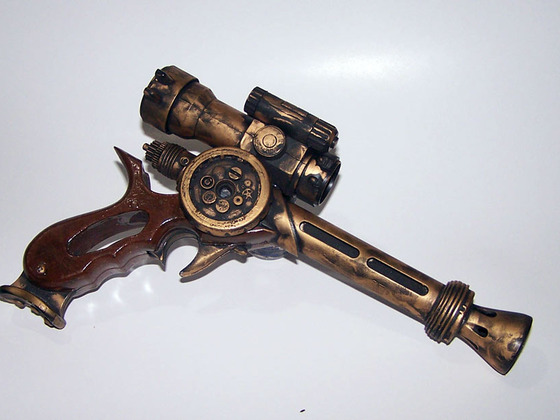
Steampunk Blaster Gun Prop

At the risk of biting into one of Regretsy's signature moves, can someone tell me what is "steampunk" about Steampunk Blaster Gun Prop?

Not pictured: steampunk


I see neither 19th-century firearm design (bolt action, lever action, box magazine), nor indications of steam power (coal hoppers, valve gears, eccentric rods). Instead, I see a perforated heat-shield and bell-shaped flash suppressor, which appear to be inspired by the Maschinengewehr 34 that Nazi Germany used to terrorize Europe during World War II. (During this period, histories tell us, steam power had stopped being cool, but was not yet "retro.") Also, I see an ergonomic grip and a reflex sight, hallmarks of handgun design only since the 1970s. Finally, I see no "punk," whatever that would mean in firearm-design terms. (A magazine held on by safety pins? Spiky day-glo iron sights?)

Could it be that an artist has used the word "steampunk" without thinking hard about what it means?

The goggles steam you, but the spats punk you.

And why call it a "prop"? Was there a danger I might think it was a real Steampunk Blaster Gun? Or is it somehow a prop within the fiction of the artist's cosplay?

That is, does his real-life steampunk circle don spats and tank tops and knee pads, get into character, and then engage in meta-cosplay about a future driven by electricity and atomic power? Does Phineas T. Cogbottom, Leftenant in Her Majesty's Aërial Dragoons, spend his R&R pretending to be Frank "Rocket" Franklin, 1937 Heisman Trophy winner and leader of the band of Earthlings standing between our planet and the evil Conqueror Wang's fleet of atom-powered Jet Auk-Men? Does Cogbottom dream of a future of vacuum tubes and ergonomic handles?

<Sydow> Pathetic Earthlings. Hurling your [cosplayers] out into the void... </Sydow>